
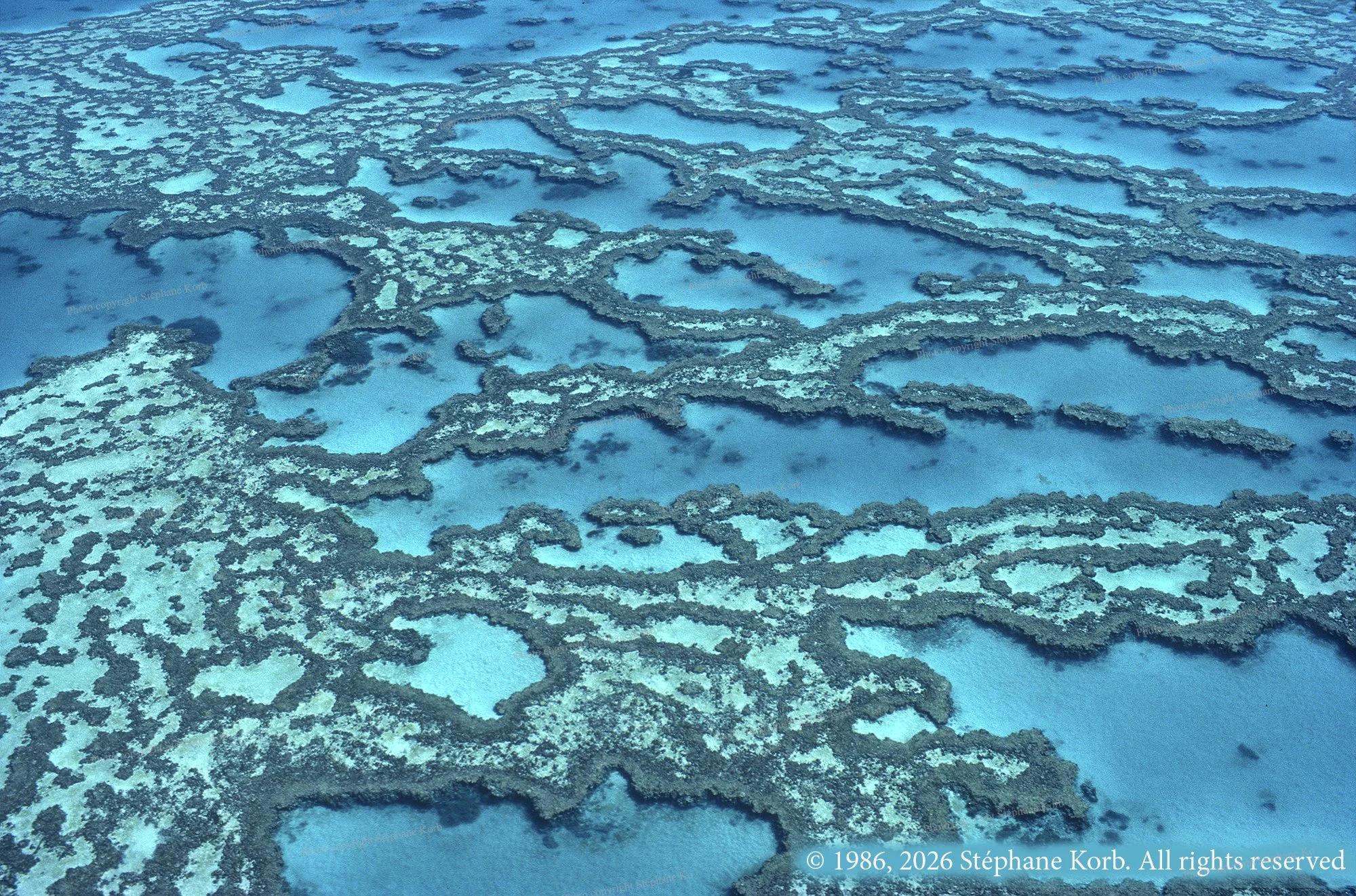
I was already familiar with Australia, having traveled there two or three times before—alone or accompanied by journalists, including François Missen—notably to cover "opal mining in the Australian mines" at Lightning Ridge, as advertised by VSD in the story published in December 1984.
During those trips, I met scientists from the University of Townsville who entrusted me with their extraordinary photos of coral reproduction, which I had published in Le Figaro Magazine on November 16, 1985. I promised myself I would return to explore the Great Barrier Reef, so I organized a week-long sea expedition aboard one of the floating laboratories belonging to AIMS (Australian Institute of Marine Science). I accompanied a team of scientists and seasoned divers.
In early 1986, I set course for Australia, carrying my scuba certification freshly earned in the deep pool at Charenton-le-Pont
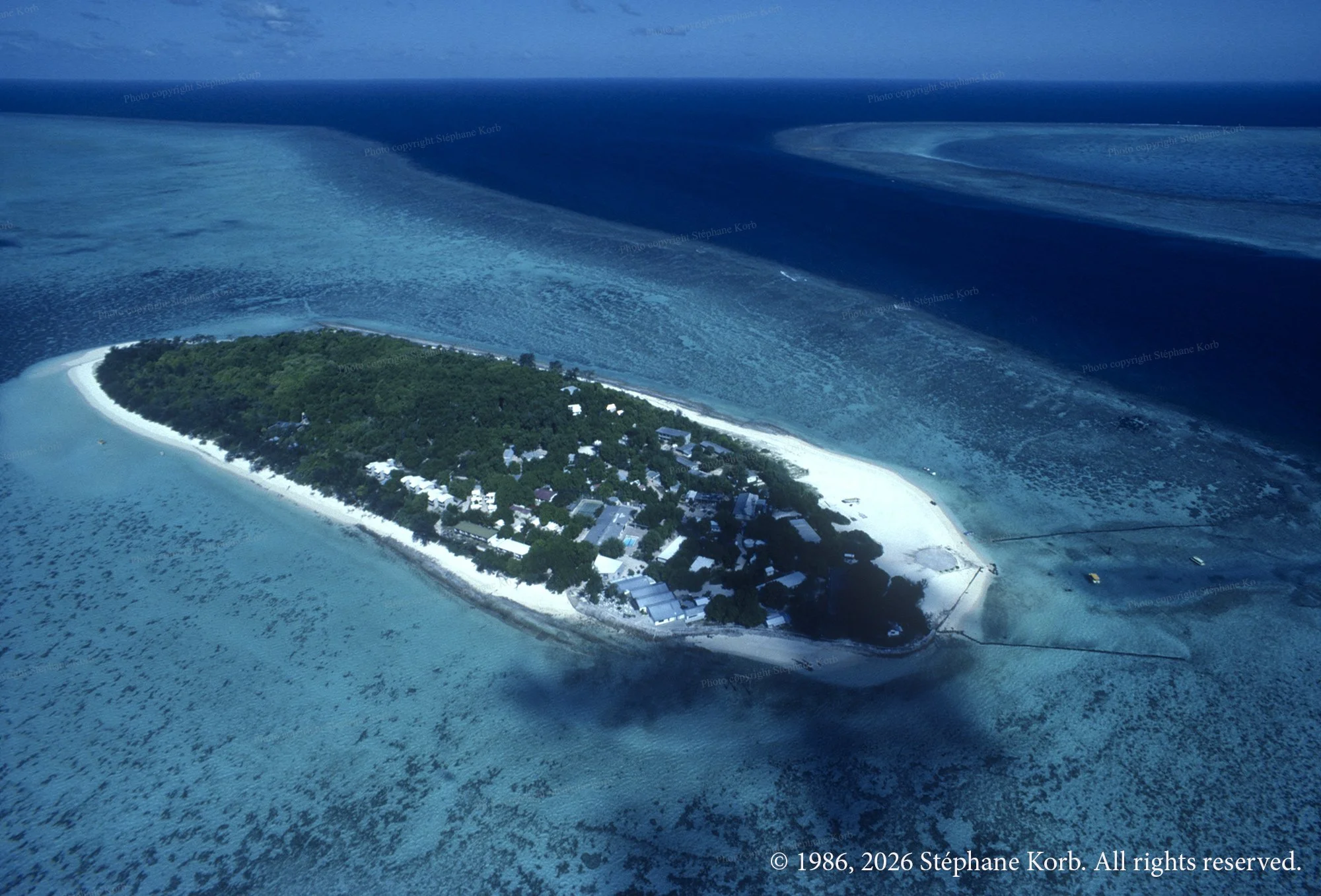
Heron Island
To get used to the marine environment, I spent a few days on Heron Island for my first ocean dives. It was hardly a success. I had immense difficulty controlling my descents and ascents, unable to achieve neutral buoyancy. Ocean diving, with its currents and unpredictability, was nothing like pool exercises. As I wrestled with my BCD, I scanned the water nervously, terrified of encountering a box jellyfish—that jelly with ten-foot tentacles armed with venomous cells capable of paralyzing the heart and nervous system. Suddenly, beneath my fins, the shape of a young tiger shark emerged, recognizable by the stripes on its back. It wove slowly through the water, right between me and the group of divers. I was petrified with fear—but alive today to tell the story.
The next day, I wanted to explore the depths to test my underwater photography skills alongside Professor Yuri Sorokin, a global pioneer in studying the role of micro-ecology and bacteria in coral reefs, who was tracking the reef's microscopic food sources
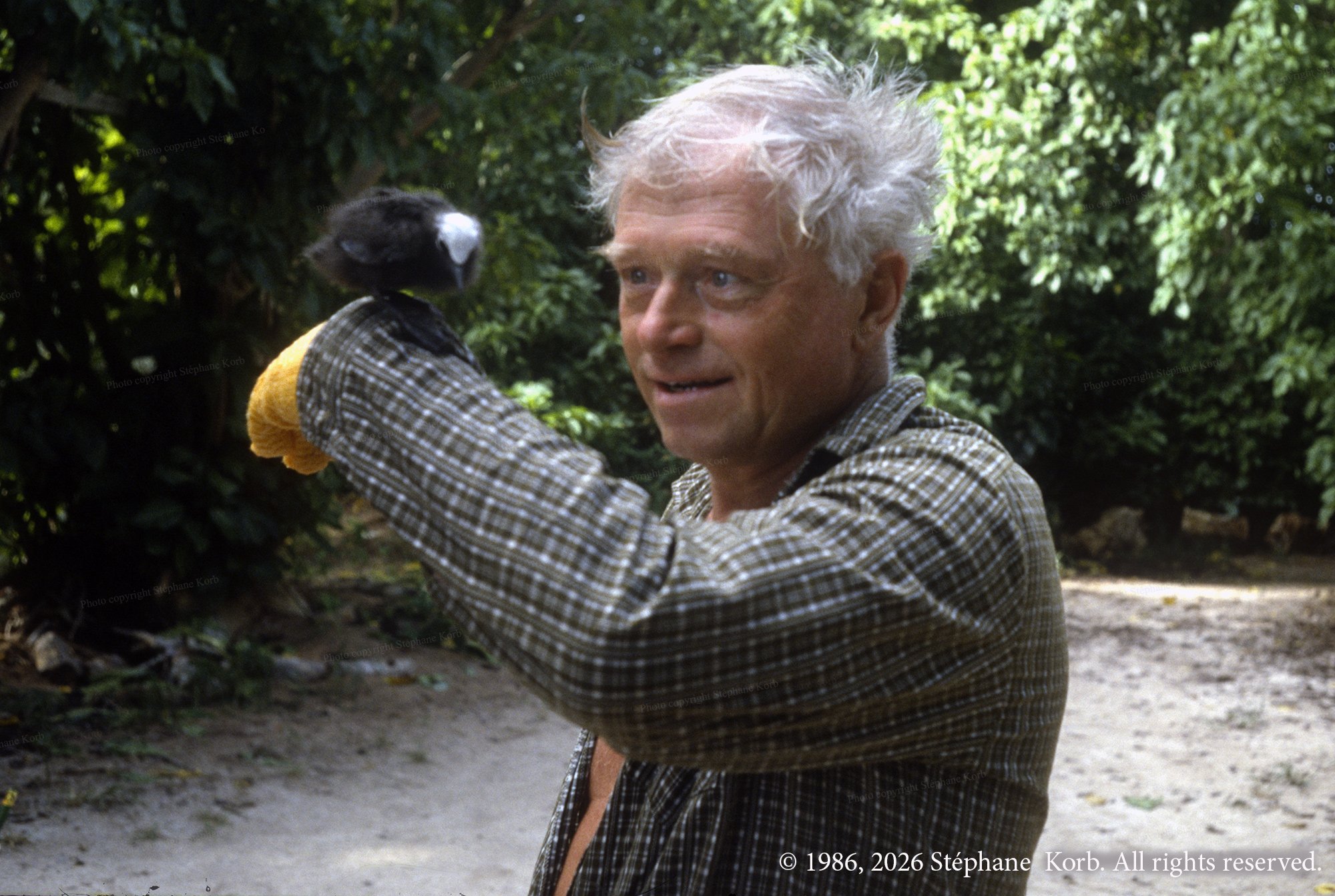
Youri Sorokin
I had never done this before and had particularly cumbersome gear: my Nikon enclosed in a watertight epoxy housing fitted with several interchangeable lenses (from 20 mm to 105 mm), flanked by a large flash mounted on articulated arms. The setup was heavy and awkward to handle. The real ordeal came when changing rolls of film. The camera had to be completely dry and dust-free before opening: climbing back onto the Zodiac, keeping everything inside dry bags, wiping myself down meticulously, and handling the gear without smearing it with sunscreen—which my hands were coated in to block the tropical UV rays. I hadn't anticipated these exhausting details that took an eternity, accustomed as I was to loading my cameras in a flash.
Heron Island is surrounded by coral heads (bomies) forming wide channels lined with white sand. That's where I dived, in barely ten or twelve feet of water, surrounded by thriving marine life. Suddenly, about sixty feet in front of me, I saw a blacktip reef shark thrashing frantically. I knew such erratic behavior spelled trouble. My only escape was to take shelter among the coral heads reaching near the surface, where the shark couldn't venture without tearing its belly open. As a result, I ended up cutting my legs and damaging my gear. Once again, more scared than hurt.
I then headed to Townsville, specifically Cape Ferguson, home to the AIMS laboratories, where we boarded our ship.
The deck was cluttered with dive tanks, microcomputers, and synthetic resin cages packed with cables and microchips. The scientists explained these were custom-built tools—a blend of cutting-edge technology and jury-rigged ingenuity. They secured them to the seafloor to analyze the exchange of oxygen and carbon dioxide between the coral and the tiny algae that sustain it.
Four of us went down for that dive. There, I was abruptly thrown into reality. David Klumpp clearly laid out the rules: we would dive to 80 feet, and I had to be fully autonomous, with no supervision or monitoring whatsoever. He checked my certification and logbook—which listed pool sessions and a few dives at Heron Island. He asked me to sign a liability waiver, advised me to breathe as calmly as possible, and told me that if I ran low on air, I should head back up to the Zodiac and wait for them. Then we rolled back into the blue.
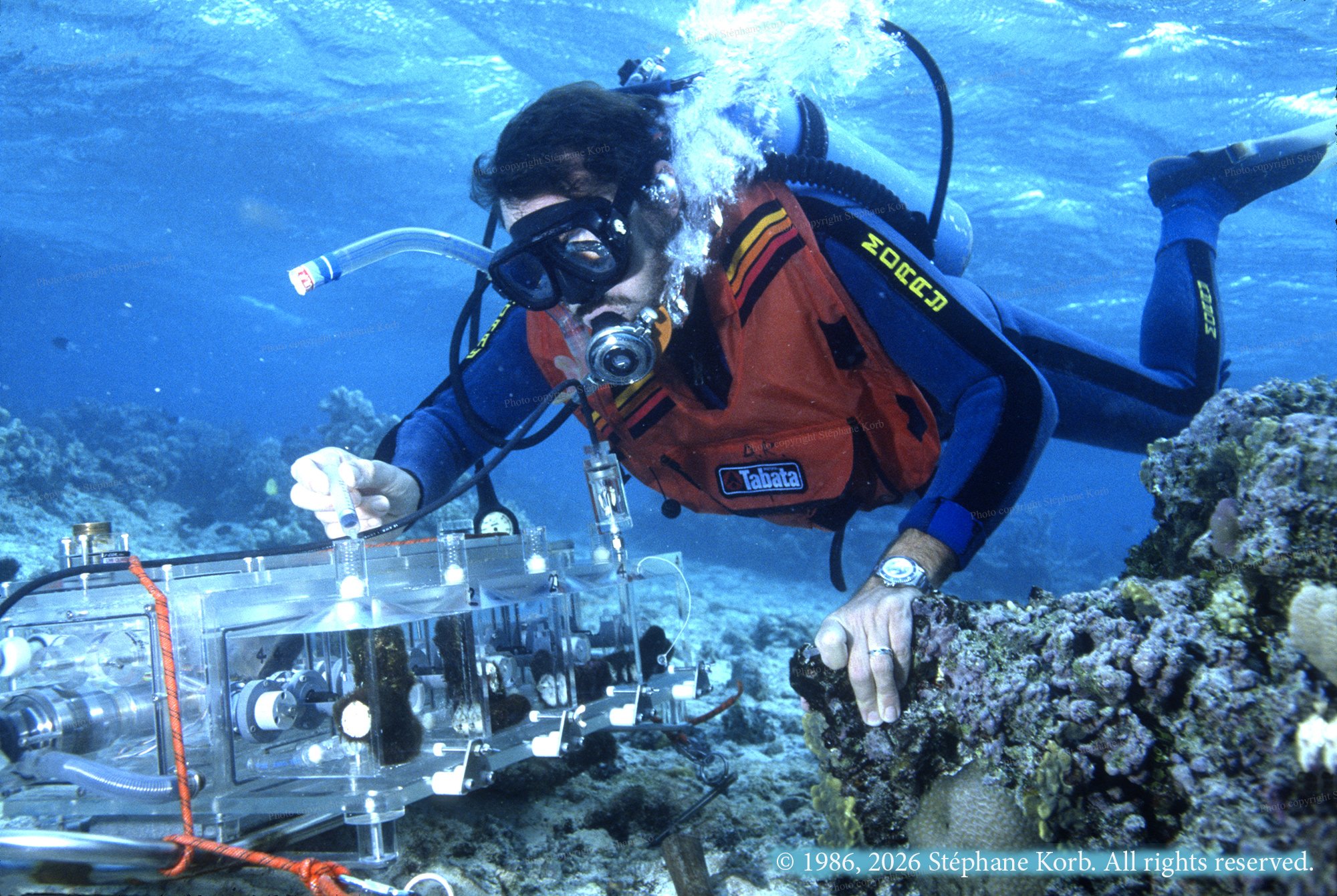
David Klumpp
Naturally, I emptied my tank faster than everyone else and had to return to the Zodiac, which was quite far away because we had drifted in the strong underwater currents. I blessed my diving instructor back in Joinville-le-Pont, who used to make us do kick drills to the point of exhaustion to toughen us up. It helped tremendously, and in the end, I got the photos I had come for—and then some.
Even back then, the Great Barrier Reef was seriously threatened with degradation. Upon returning to Paris, I pitched my photos to several editorial teams. Ça m’intéresse magazine decided to feature them in a major report. They liked the topic, but it required additional field reporting. The magazine granted me a budget, an airline ticket, and a guarantee to credit the organizations supporting me logistically at the end of the feature.
I returned in November of that same year. At that time of year, temperatures rarely drop below 86°F during the day, and the nights remain stifling. It was the start of the rainy season, with humidity climbing above 65%. Arriving on site with a mild cold I had ignored, the oppressive heat kept me from realizing my fever was spiking. Behind the wheel of a rented Méhari, I felt free as a bird and sped off to shoot a series of portraits at AIMS in Cape Ferguson. I photographed John Coll, who was isolating chemical substances to develop medicines of the future; Peter Isdale, who traced climate history back a thousand years through coral cores; Peter Moran, fighting the formidable crown-of-thorns starfish; Bruce Chalker; Terence J. Done; and many other passionate researchers
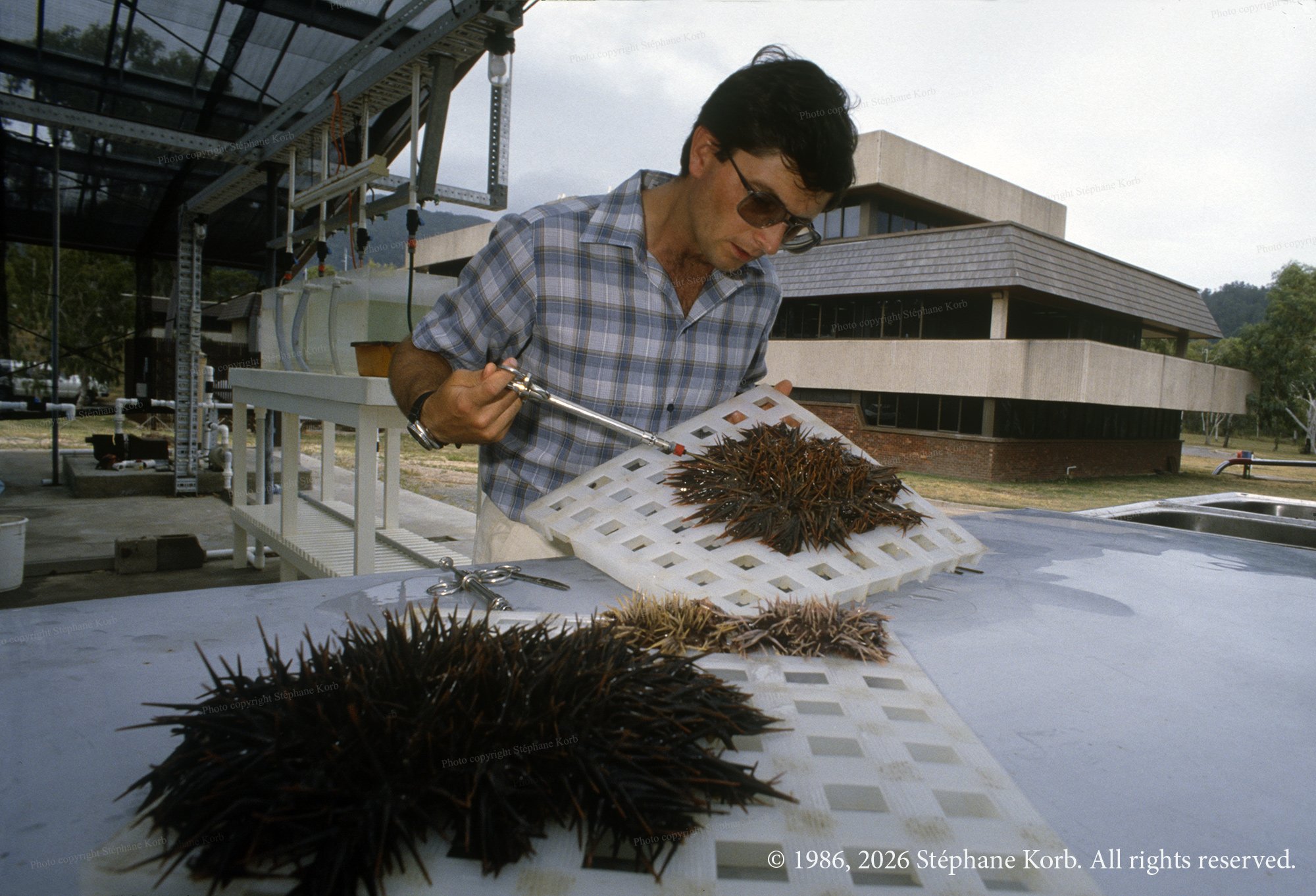
Peter Moran
By the end of the day, overwhelming fatigue and a heavy chest pain brought me to a halt. I was completely out of breath; climbing two stairs felt impossible. I managed to limp back to Townsville, where I remained bedridden for a full week with a severe lung infection, treated with nothing but absolute rest. I took advantage of the downtime to organize my notes and send them to Paris so journalist Dominique Martin-Ferrari could write the article.
The feature was published in January 1987 under the headline: "Warning: A Paradise to Save."
The press is often called the "fourth estate," but in the face of climate disruption, that power proved to be an illusion. Forty years later, in 2026, the Great Barrier Reef is even more dramatically threatened than it was in 1987. The reef once possessed incredible resilience, but the relentless sequence of marine heatwaves and recurring bleaching events has finally exhausted its capacity to recover.
—————————————————————————————
The photographs featured in this article come from a complete photo reportage. For any inquiries, feel free to contact me here
