
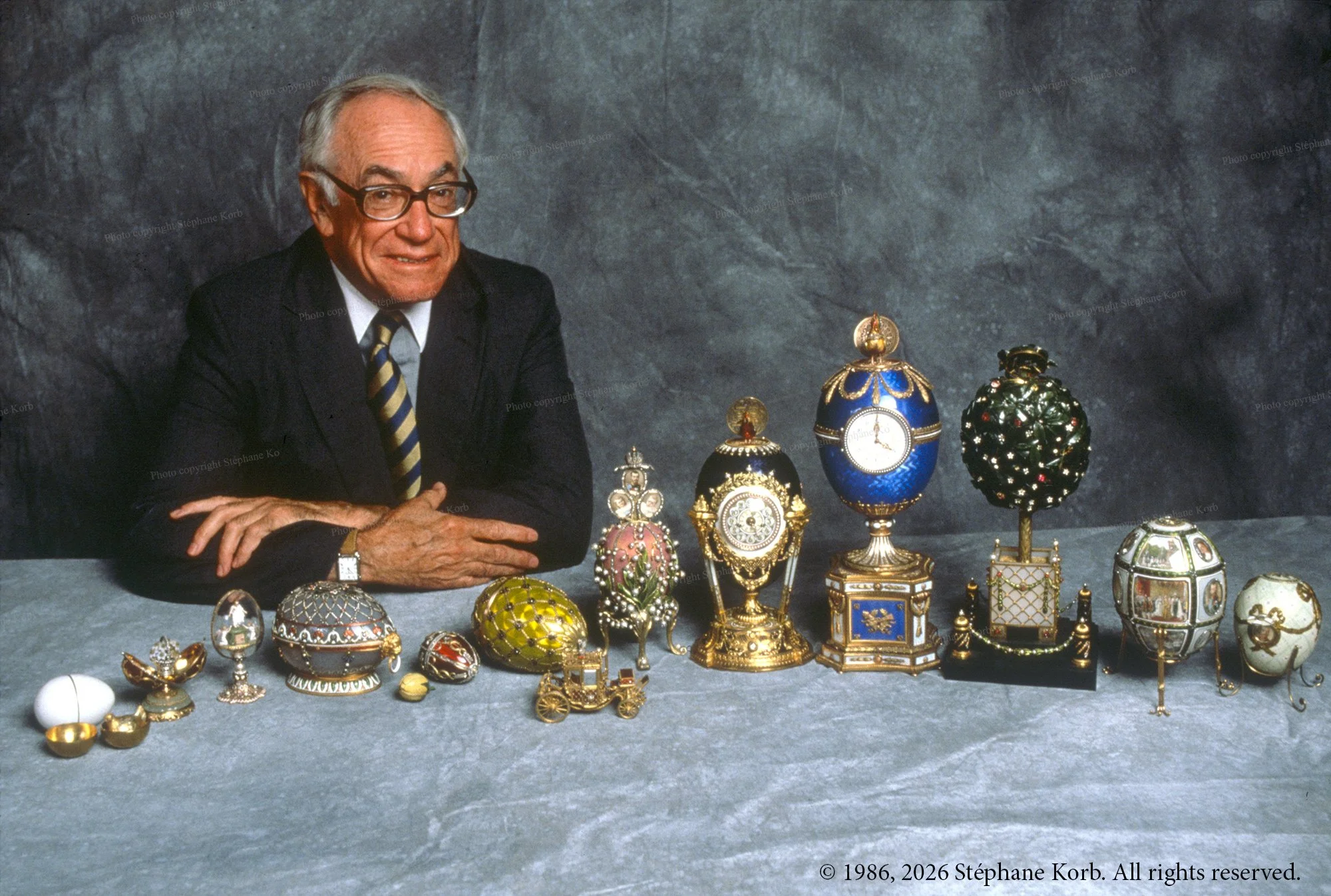
Malcolm Forbes and his collection of Imperial Fabergé eggs at the Forbes Gallery, New York
I had been going to New York for a few years, and I believe that’s where I ran into Dmitri Savitsky, a Russian writer, poet, and journalist, as well as a key figure of Soviet cultural dissent and Paris emigration. He was in New York at the time doing some reporting, and we met at the home of jazz musician Lloyd McNeill.
Dmitri was a man full of enthusiasm, and we later collaborated on several assignments. He introduced me to some very interesting people in Little Odessa, including Yury Radzievsky, a former star captain on Soviet television turned influential businessman running a major New York agency, and Vladimir Teteriatnikov, an essential expert on Tsarist art and a sharp connoisseur of the secrets and controversies surrounding Russian artwork. A fascinating character.
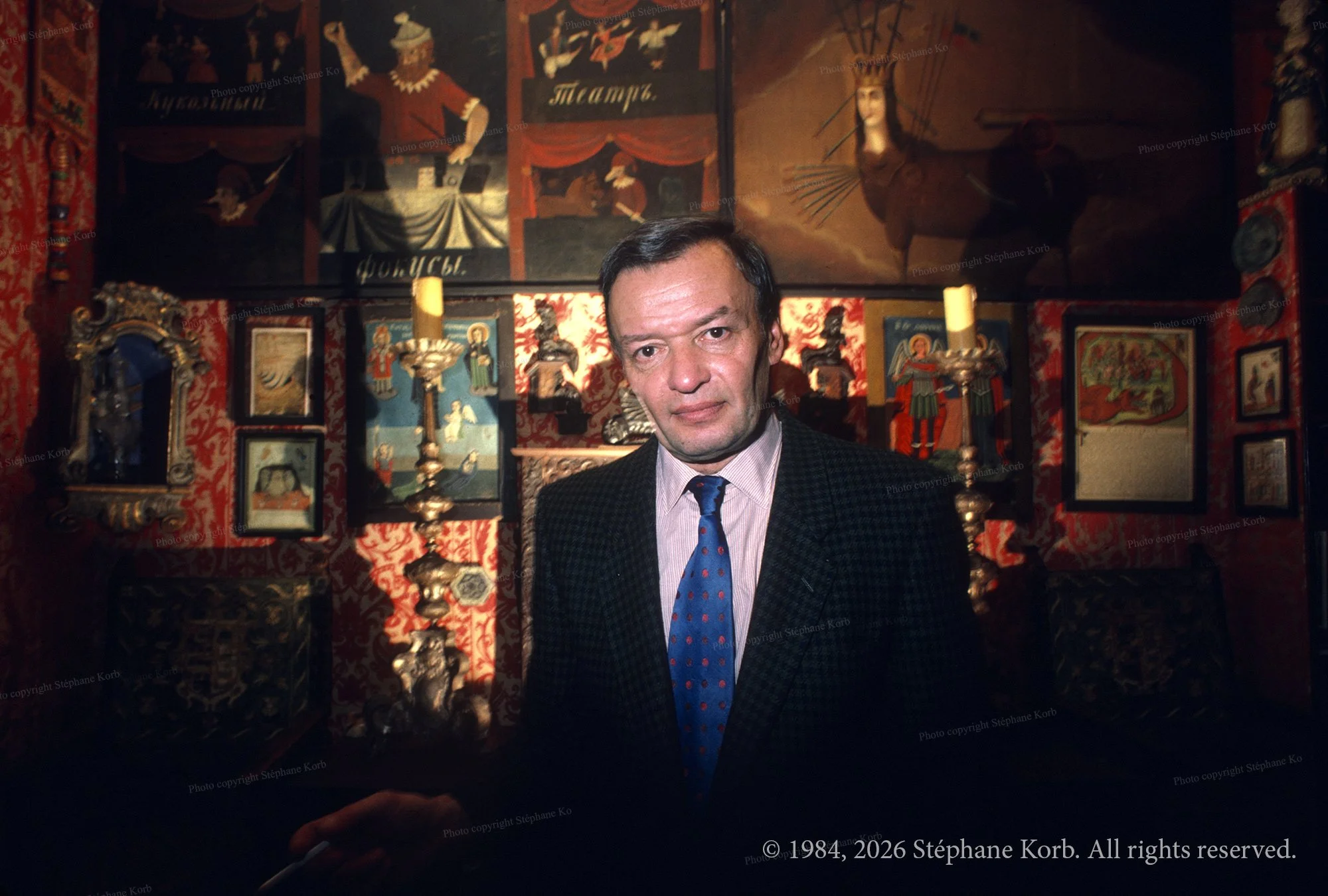
Vladimir Teteriatnikov at home in New York, 1984
Vladimir told me that an Imperial Fabergé egg was going up for auction at Sotheby’s and, according to him — this is the first time I’m mentioning it —, the egg was a crude assembly of flashy components that had nothing to do with Fabergé’s aesthetic and quality, held together by rusty screws and nails, and on top of that, very poorly made.
He suggested I go photograph some of the details on this jewel, which I did. I was no expert and my opinion held no weight, but I could see an obvious lack of meticulous detail that didn’t match the flawless, high-end execution characteristic of Carl Fabergé’s jewels.
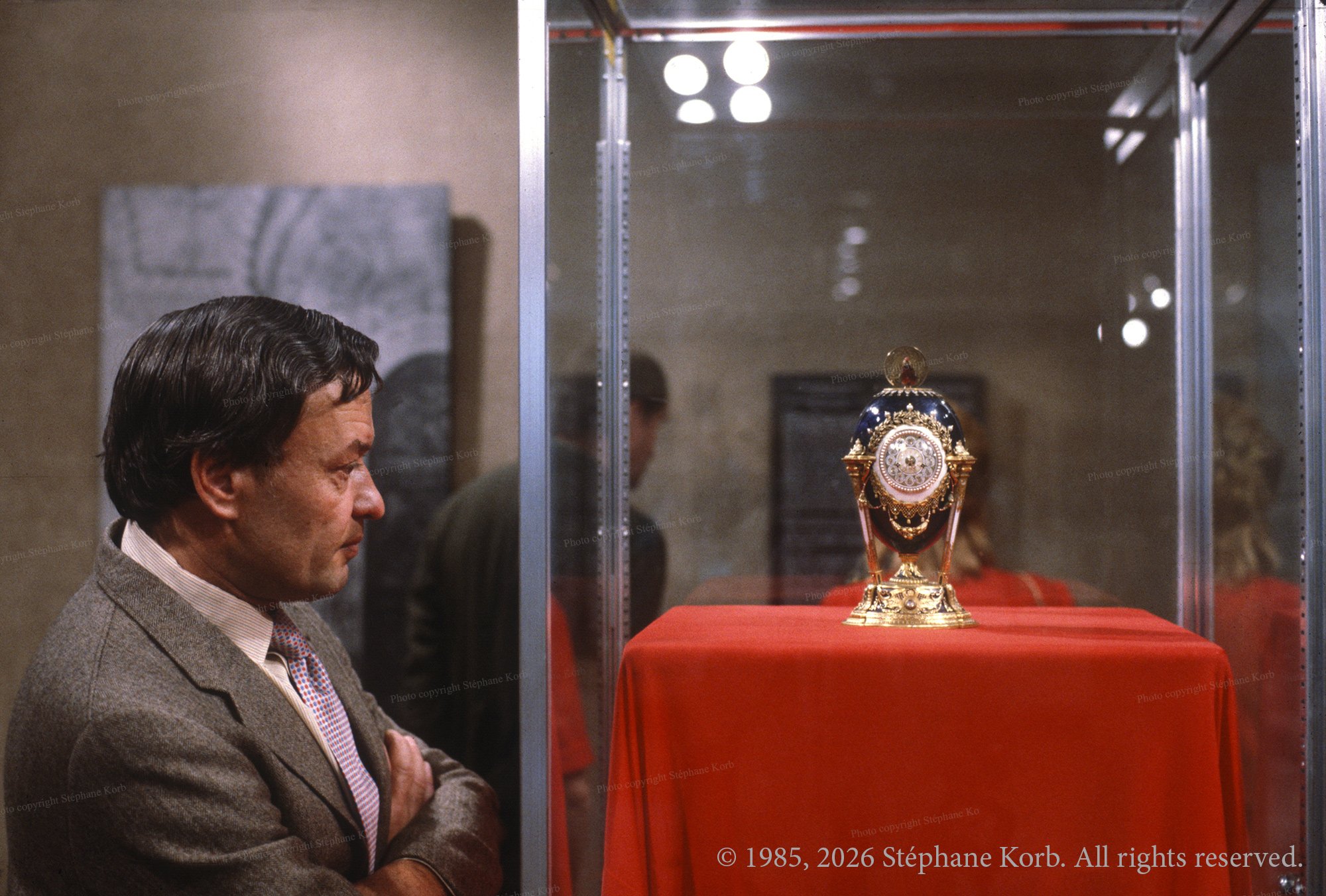
Vladimir Teteriatnikov at Sotheby’s
The staff at Sotheby’s was extremely cooperative. To my great surprise, they immediately gave me permission to take the photos, and I was left alone in a room with this egg, which had an estimated starting bid of 300,000 dollars. Later on, they invited me to photograph the auction in June 1985. An assistant stood beside me, and she was the one who pointed out the man bidding in the room, toward whom everyone’s eyes seemed to turn. “That’s Malcolm Forbes,” she told me. I didn’t know who he was. He won the auction, and the egg went for 1,600,000 dollars — 1,760,000 including fees. At the time, this amount was a world record for a Fabergé piece sold at auction and allowed Malcolm Forbes to reach the symbolic milestone of 11 eggs in his personal collection. The seller had a smile stretching from ear to ear.
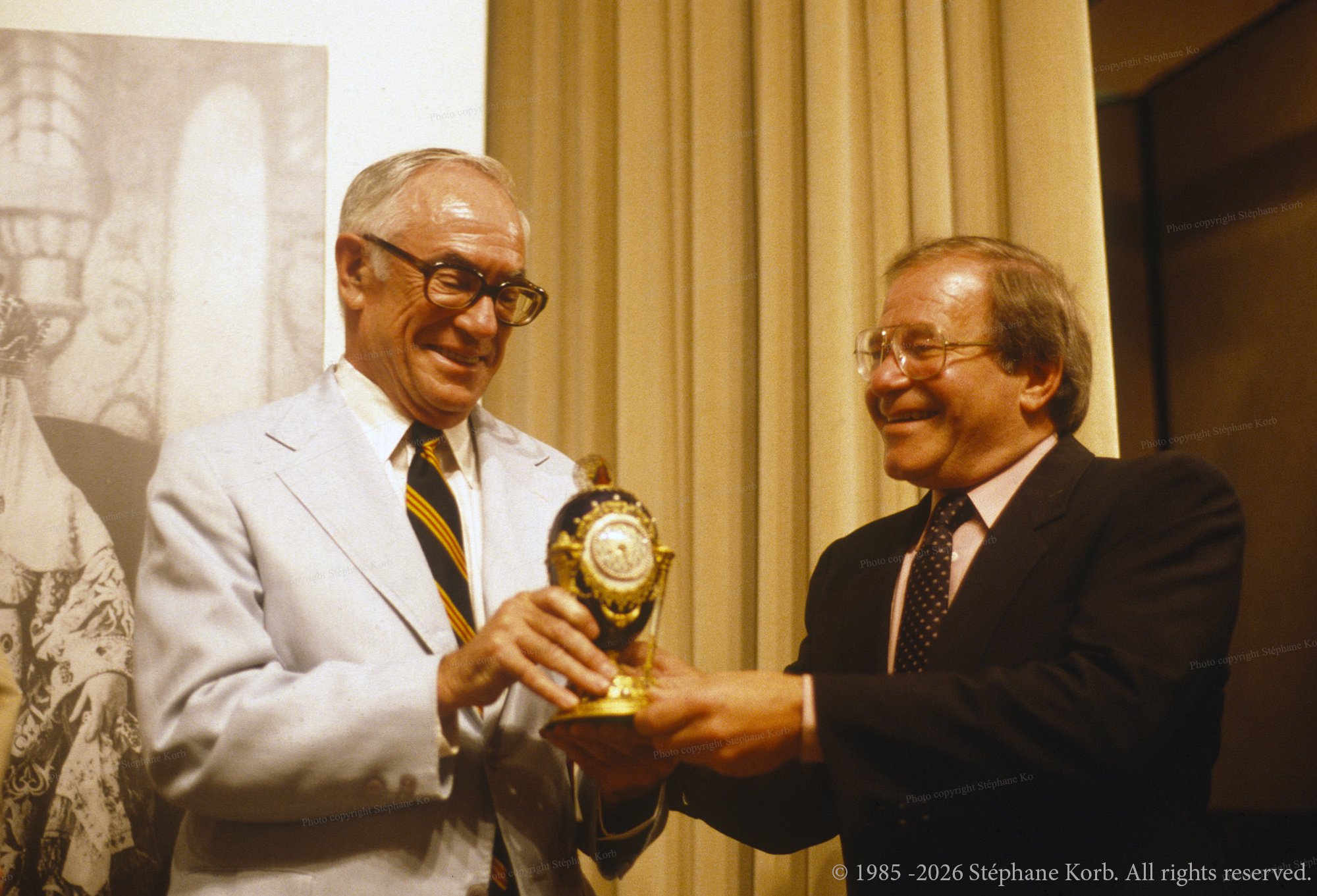
Malcolm Forbes and Henry H. Salomon with the $1,600,000 egg
A few journalists were asking Forbes questions, but there was a kind of invisible barrier; I realized later that they knew the power of his media and financial empire. Fortunately for me, Forbes was a stranger to me, and luckily, no journalist dared to ask him the question burning on the tip of my tongue.
But anxiety was creeping over me: among those American journalists, there were very likely representatives from major media outlets that I couldn't compete with, and I worried at every moment that one of them would beat me to it. As soon as they finished talking, I approached Forbes. Mixed with that fear, my impatience was such that I instinctively grabbed his arm, asking if I could photograph him exclusively with his collection. He was taken aback and, after a brief second of thought, said to me with a broad smile, “Alright, set that up with my son Christopher.” Then he left, accompanied by the Schaffer family, owners of the famous shop A La Vieille Russie.
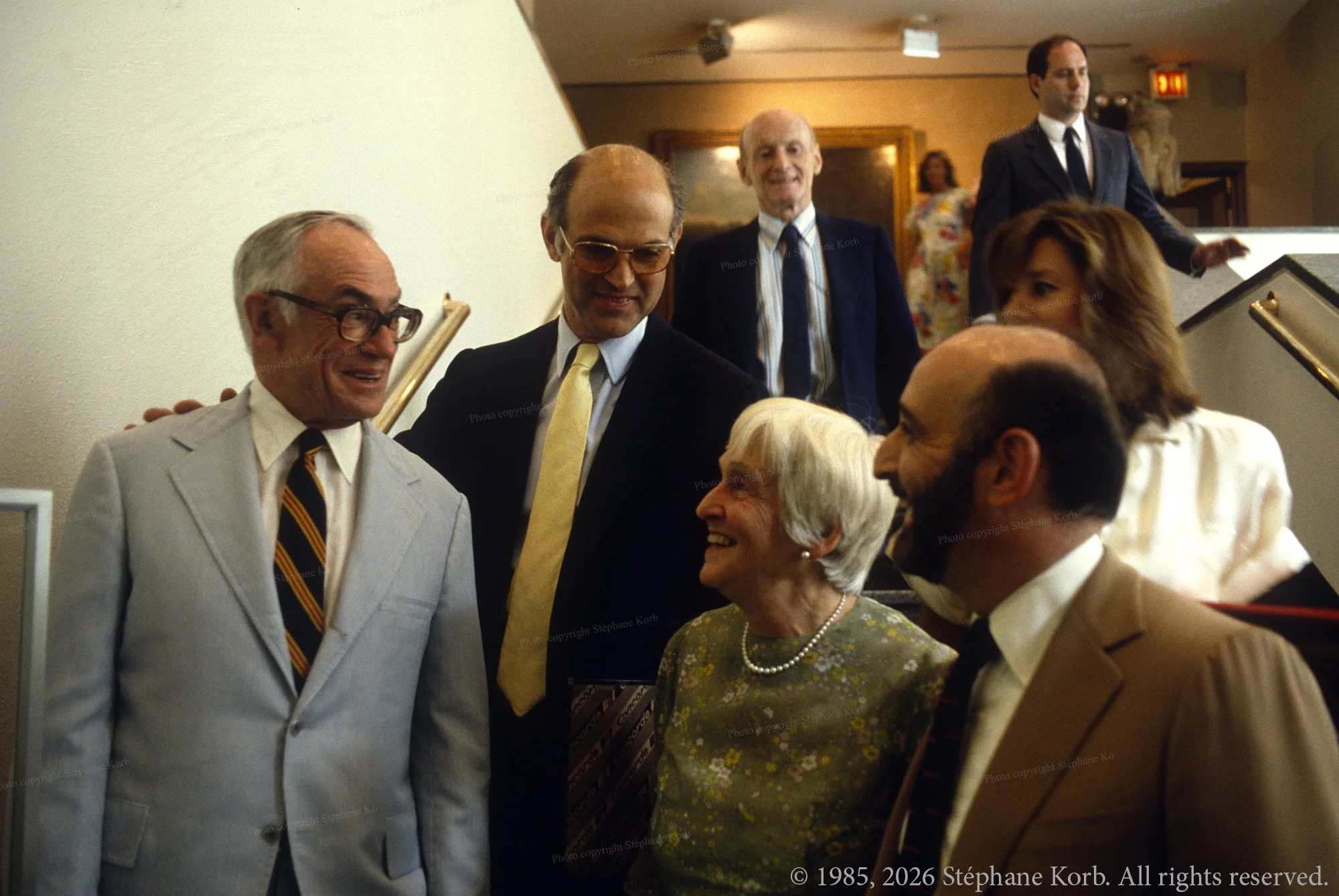
Malcom Forbes, Paul, Ray and Peter Schaffer
I did a first photo session, and Christopher posed with his father. For the occasion, I had opted for a black background, which seemed like a good idea at the time, but didn’t turn out very well. So I asked for a second photo session, which he agreed to. This time, I had bought a large cotton canvas that I painted and dyed myself in shades of crumpled gray. From Paris, I had contacted an assistant who owned a Hasselblad, lighting gear, and a car, and then I left for New York. The studio was set up inside the Forbes Gallery on 5th Avenue, and I asked the gallery staff to place the eggs themselves; otherwise, they would have let me handle them, and I didn’t want to take that risk.
I then had someone let Forbes know he could come in. He sat down and, with a big smile, said to me, “What do you want me to do? Throw them in the air to make an omelet?” I started shooting. Hasselblad cameras are very practical with their interchangeable backs. I had asked the assistant to load four of them and pass them to me. I shoot a roll, change the back, shoot a second roll... and the assistant doesn’t pass me the third back. I look away from Forbes for a few seconds to bend down and grab the back myself, and I hear Forbes say, “Is that it? Goodbye.” I was left standing there, terrified that I had missed the shot. Without packing up the studio, I left everything as it was to make sure I could redo the whole thing if there was a problem, and I rushed over to the Duggal lab, which was twelve blocks away — a ten-minute cab ride — and requested a super rush development. An hour later, to my immense relief, I saw that the photos were good, even though I hadn’t had time to have Forbes pose in different ways. I finished the session by photographing the eggs, and we cleared the equipment out of the Forbes Gallery.
That series, shot against a gray background that was much easier on the eyes, was the one mostly published.
In early 1987, as the exhibition of the Forbes collection at the Musée Jacquemart-André approached, Expression — a lavish, very thick monthly magazine at the time, published by Execom and backed by American Express — offered me a solid guarantee for the exclusive publication of these photos. Given the magazine’s high circulation, I accepted. But a month before publication, the editor called to warn me about budget cuts that required reducing the print run, which meant my pay would be cut too. Notified at the last minute, I only had one thing to do: I pitched the story to Jours de France, which accepted it immediately.
I waited until the day before publication to notify L'Expression, which threatened me with a lawsuit just for show. As for Forbes, whom I showed the publications to after his visit to the Musée Jacquemart-André in Paris, he was very happy.
Later on, I went to see Jimmy Fox, showed him my photos, and told him about all these twists and turns. Jimmy told me to leave the images with him and that he would have them distributed by Magnum. I was extremely proud. Jimmy Fox was a major, highly respected figure in the world of photography and photojournalism. He worked at Magnum as its editor-in-chief, renowned for his exceptional critical eye and his talent for selecting the best images sent in by top photographers around the world. That’s how my images ended up being distributed internationally under the credit Stéphane Korb / Magnum Photos, landing in the pages of major publications like Life (January 1991), The Sunday Times Magazine supplement, ENA magazine (April 15, 1990), and likely many others I’ve never even seen.
But the story didn’t end there. When Malcolm Forbes passed away in 1990, I immediately went to see Paris Match to show them my photos. There was a strange mood in the air, and then Michel Sola, the chief photo editor, came up to me and didn't pull any punches: “Stéphane, you’re a liar. And he showed me a series of photos of Malcolm Forbes, including mine, all credited to an American photographer and distributed worldwide by a rather sketchy agency. That photographer had raided Forbes’ photo library for all the images he liked, slapped his own stamp on them, and sent the whole batch out to international magazines. Luckily, I was able to prove my ownership and save the sale with Match and a few other monthlies, but the whole ordeal hurt my reputation for a while.
———————————————————————————————————————————
The photographs featured in this article are from a comprehensive photo essay including dozens of shots. For any inquiries, you can contact me here.
